Regenerative Works Coop: pilot invitation
Dear Rachel, Tony, Em, Maria, and Kat,
I’d like to invite you to co-develop what I’m calling “Regenerative Works Coop”: a cooperative structure emerging out of the local regenerative and syntropic agriculture workshops, and the work done through the Strovolos Living Lab.
What I have in mind is a simple, fair structure that can take on and delegate practical and consultative regenerative projects around Cyprus: gardens, landscapes, community-based work, and collaborations that sit somewhere between design, implementation, advice, logistics, and care.
I’m interested in building something that can hold projects well, allow people to contribute in different ways, and continue beyond one-off arrangements, while making sure that the work supports both the people doing it and the continuity of the Coop itself.
I see my own role as steward of the structure: holding the ethos, coordination, transparent financial management, and overall viability of the Coop, while projects themselves are carried by the right team for the job.
For this first pilot, I would love to invite you in as follows:
- Rachel and Tony: in a permaculture / regenerative growing capacity, helping shape the pilot through your knowledge, practical input, and advice
- Tony also, where useful, in relation to accounting and coordination
- Em: in local coordination, logistics, and cooperation
- Kat: by offering your new garden as the pilot site, and by helping us test the concept in practice
- Maria: in a hands-on as well as a biodynamic capacity, helping bring biodynamic understanding and practice into the pilot where relevant
My hope is that this first pilot can help us test both a regenerative intervention in one place and a way of working together that we’d actually like to keep building on.
In practical terms, I imagine projects undertaken through the Coop including:
- a strong regenerative ethos and alignment with permaculture principles, contributing to their adaptation in Cyprus, and the capacities of the team, context, and resources of each project,
- fair payment for the people doing the work
- a transparent contribution to coordination and the cooperative’s continuity
- where possible, a small contribution toward shared capacity, training, or future community-benefit work
Part of what is behind this is a problem I’ve run into myself. I’ve wanted regenerative help with my own garden and found it surprisingly hard to create something sustainable: a way of bringing together consultation, practical help, learning, and fair payment without everything depending either on unpaid goodwill or on expensive one-off arrangements. Over time I’ve tried to bridge that gap by educating myself further, doing work exchanges where possible, and hiring people when I could.
What I’d like to do now is turn that experience into a structure that others can also use:
- practitioners, consultants, and people in the process of learning, who are looking for opportunities to collaborate, consult, and gain experience, locally or remotely
- people who have land, some resources, and a genuine wish to do things well, but don’t have an easy way to connect with the right people and build something coherent
Part of what interests me here, too, is creating a framework that can help strengthen and demonstrate a regenerative way of working in Cyprus. I would also like it, over time, to bring in and train people who need work and would benefit from supported, meaningful participation in regenerative projects.
If this resonates with you, I’d love to hear back with your initial response: whether you’d like to be part of the pilot, what role you might be open to playing, and any thoughts or concerns you’d want on the table from the outset. If there’s enough shared interest, I’d then love to gather and shape it together.
With love,
Chrystalleni
Book launch including Chapter by Eimaste- Deep Commons: Cultivating Ecologies of Solidarity and Care Beyond Capitalism, Patriarchy, Racism and the State (2026)
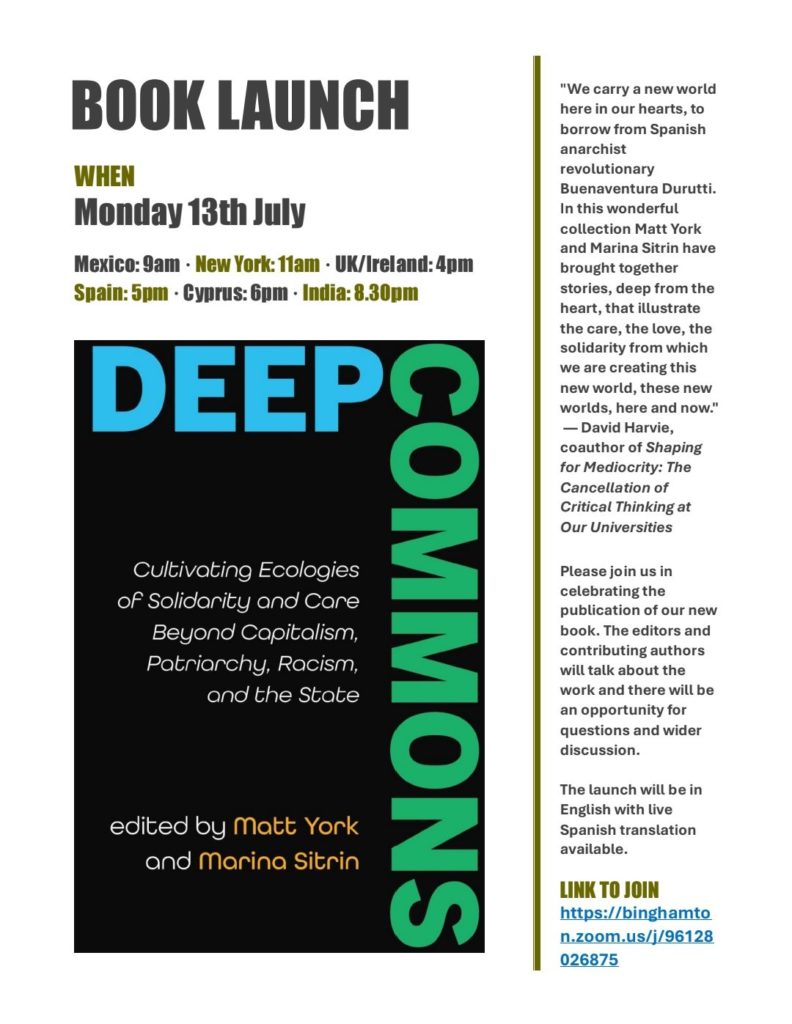
Please join us in celebrating the publication of our new book!
Deep Commons: Cultivating Ecologies of Solidarity and Care Beyond Capitalism, Patriarchy, Racism, and the State
Monday 13th July
Mexico: 9am · New York: 11am · UK/Ireland: 4pm · Spain: 5pm · Cyprus: 6pm · India: 8.30pm
The launch will be in English with live Spanish translation available.
Zoom link for event:https://binghamton.zoom.us/j/96128026875
Recent years have witnessed an organized global backlash of authoritarian politics with a resurgence of xenophobic nationalisms, colonialism, racism, anti-feminist movements, climate denialism, and the purposeful undermining of existing democratic systems. In response, Deep Commons invites us to instead cultivate radically different political communities of solidarity and care. Linking ecological, anti-capitalist, feminist, Indigenous, and animal liberation politics intersectionally, activists and scholars from the growing Deep Commons community, representing a diversity of positions between the core and periphery of empire, share concrete examples and grassroots lived experiences of these liberatory psycho-socio-material relations. The book therefore focuses through one key question: How do we do it? How do we cultivate ecologies of solidarity and care beyond capitalism, patriarchy, racism, and the state?
“We carry a new world here in our hearts, to borrow from Spanish anarchist revolutionary Buenaventura Durutti. In this wonderful collection Matt York and Marina Sitrin have brought together stories, deep from the heart, that illustrate the care, the love, the solidarity from which we are creating this new world, these new worlds, here and now.” — David Harvie, coauthor of Shaping for Mediocrity: The Cancellation of Critical Thinking at Our Universities.
More details on book: https://sunypress.edu/Books/D/Deep-Commons
Rachael’s “What Does Regenerative Water Harvesting Look Like?”
https://docs.google.com/presentation/d/1paFFWXGObrB5JnbkLg1hzqqhF-wfSSeem9JZ19lr89w/edit?usp=drivesdk
Driving Urban Transitions in Acropolis Park
This is part of the EU’s Driving Urban Transitions Partnership. We’re creating Living Labs that connect sustainable food production, community inclusion, and circular economy practices. In Strovolos, we’re turning urban spaces into hubs for regenerative farming and social innovation, involving migrants, youth, women, and the elderly in co-creating resilient local food systems.
Local TV coverage
https://www.facebook.com/reel/1161233425504325
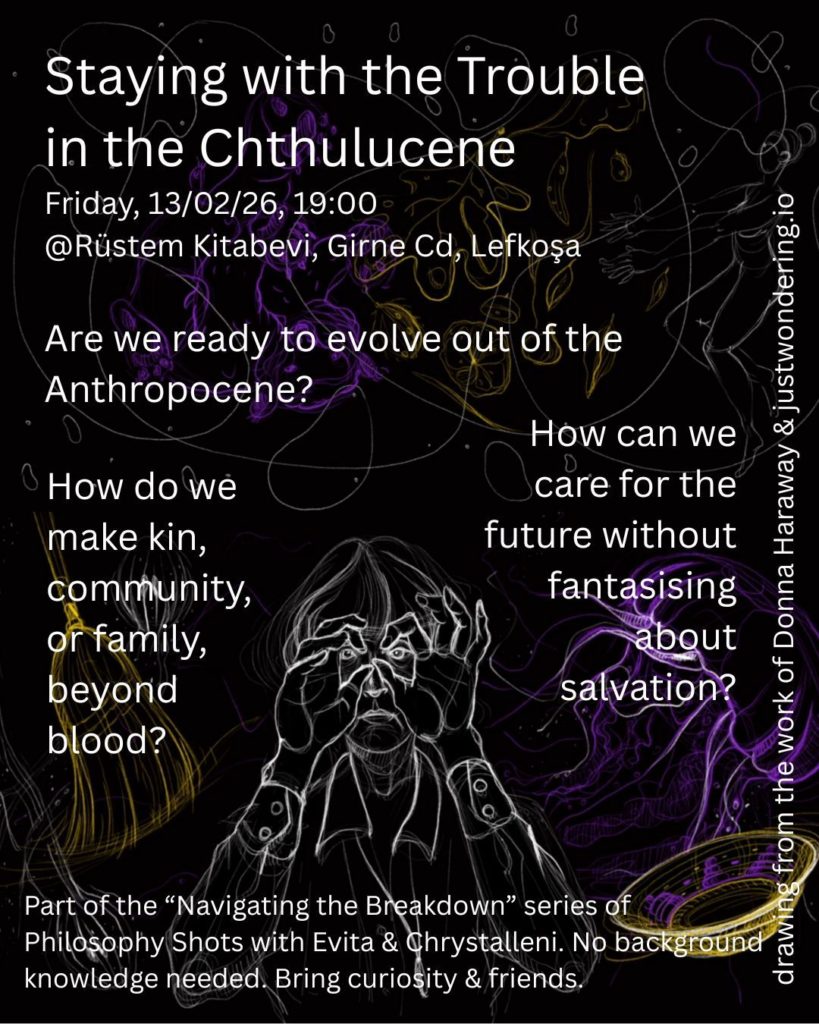
🌀 Philosophy Discussion Series: Navigating the Breakdown 🌀
Introducing an arc of 4 philosophical discussions in the beloved Philosophy Shots tradition: from Cory Doctorow’s Enshittification to Donna Haraway’s Staying with the Trouble
We (Evita & Chrystalleni) have found ourselves trying (both intellectually and emotionally) to get a handle on some of the paradoxes of our time: the shared need to navigate (& repair?) a collective sense of doom in relation to international and local politics / community & ecological collapse / the domination of exploitative tech and so on –even as we experience the utopian blossoming of networks such as this one! Out of our need to share notes with more people (you) came an offering of a series of Philosophy Shots, starting this Thursday November 6th.
This picks up from Cory Doctorow’s notion of “Enshittification” or the observation that the internet (considered by some as a manifestation of humanity’s collective unconscious) is just getting increasingly shit. From there we’d like to bring in contemporary thought on the workings of power, post-capitalist theory, and see if we can go into a bit of tech & AI ethics.
Continue reading “🌀 Philosophy Discussion Series: Navigating the Breakdown 🌀”
Εισηγήσεις Θεμάτων για την Γενική Συνέλευση Συνδέσμου Γονέων – A Δημοτικό Αγλαντζιάς
Αγαπητές/οι,
Με αφορμή την επικείμενη Γενική Συνέλευση του Συνδέσμου Γονέων, θα ήθελα να προτείνω ορισμένα θέματα, με στόχο την καλύτερη οργάνωση, διαφάνεια και ενδυνάμωση της κοινότητάς μας:
- Διαδικασίες και Διαφάνεια
- Χρήση κοινών εγγράφων (shared documents, online) για τα πρακτικά, για έγκαιρη/αυτόματη κοινοποίηση ατζέντας, συλλογή θεμάτων προς συζήτηση, και καταγραφή αποφάσεων.
- Εφαρμογή αρχής «ανοιχτών βιβλίων» για τον προϋπολογισμό και τις δαπάνες.
- Δημοκρατική Συμμετοχή
- Δημιουργία ομάδων εργασίας με συμμετοχή και γονέων εκτός συμβουλίου.
- Άνοιγμα ευκαιριών για αντιμετώπιση νέων θεμάτων και προτάσεων κατα τη διάρκεια του χρόνου.
- Διασφάλιση ότι όλες οι προτάσεις συζητούνται με επαρκή χρόνο πριν από την ψήφιση.
- Εφαρμογή πρακτικών για εποικοδομητική διαχείριση διαφορετικών απόψεων χωρίς προσωπικές συγκρούσεις.
- Στρατηγικός Σχεδιασμός
- Αναθεώρηση του μοντέλου fundraising και δράσεων.
- Αναθεώρηση του ρόλου των Συνεδριάσεων ως συντονισμός των ομάδων εργασίας (η λεπτομερής οργάνωση δράσεων αφήνεται σε ομάδες εργασίας).
- Σχεδιασμός διαδοχής (succession planning) ώστε να ενθαρρύνεται η ενεργός συμμετοχή νέων γονέων, να μην δημιουργούνται σημεία συμφόρησης (bottlenecks), φαγμοί συμμετοχής (gatekeeping), ούτε εξαρτήσεις από συγκεκριμένα άτομα (single points of failure).
- Επικοινωνία με Γονείς
- Δημιουργία mailing list και τακτική ενημέρωση.
- Δράσεις δικτύωσης και ενδυνάμωσης της συμμετοχής όλων των γονέων, με έμφαση στη φιλική και ανοιχτή συνεργασία.
- Μετάβαση από την νοοτροπία ότι «οι περισσότεροι γονείς δεν ενδιαφέρονται» και καλλιέργεια της πεποίθησης ότι όλοι οι γονείς μπορούν να συνεισφέρουν με μικρές συνεισφορές χρόνου ή δεξιοτήτων.
- Συνεργασία με το Προσωπικό και την Κοινότητα του Σχολείου
- Συναντήσεις ολόκληρου του Συμβουλίου και, ανάλογα, με των ομάδων εργασίας, με τη διεύθυνση και τους εκπαιδευτικούς για καλύτερο συντονισμό.
- Συστηματική ενσωμάτωση αναγκών και εισηγήσεων του σχολικού προσωπικού στις δράσεις του Συνδέσμου.
- Αξιοποίηση των δημογραφικών στοιχείων του σχολείου για καλύτερο σχεδιασμό δράσεων.
- Ενσωμάτωση αναγκών της σχολικής κοινότητας στις αποφάσεις του Συνδέσμου.
- Συμμετοχή στην Ομοσπονδία και συνεργασία με άλλους Συνδέσμους και Φορείς
- Ενίσχυση της παρουσίας του Συνδέσμου σε συνελεύσεις και εκδηλώσεις της Ομοσπονδίας Συνδέσμων Γονέων.
- Άνοιγμα καναλιών για συνεργασία με Συνδέσμους γειτονικών σχολείων, π.χ. για εκδηλώσεις ενημέρωσης γονέων.
- Μελέτη ευκαιριών χρηματοδότησης και συμμετοχής σε Ευρωπαϊκά και άλλα προγράμματα σε συνεργασία με άλλους φορείς.
Πιστεύω ότι η συζήτηση αυτών των θεμάτων και εισηγήσεων θα συμβάλει σημαντικά στη βελτίωση της λειτουργίας και της δυναμικής του Συνδέσμου μας.
Με εκτίμηση,
Χρυσταλλένη Λοϊζίδου
Help Patrick Rebuild his Djembe workshop & animal shelter after the Fires in Koilani
Patrick, our formidable, internationally respected and locally loved, craftsman of djembe drums, has been directly affected by the recent fires in the Limassol mountains. His workshop equipment has suffered considerable damage, though his home and the 23+ animals in his care have survived. He has been without electricity and basic resources for several days, with no clear indication of when conditions will improve or whether support will come.
Patrick has chosen to stay in Koilani to care for the animals and protect what remains of his craft materials, amid reports of increased theft in the area since the disaster.
If you would like to support him and safeguard the continuation of his craft, please contact Patrick directly to discuss his most pressing needs (+357 99 28 60 18) or get in touch with Chrystalleni (+357 99 58 63 69) for his bank details.
May it circle!
Call to Participate: Our Deepest Wounds Are Our Greatest Gifts – Vol.1 w/ Izzeddin Qassem
[edit: This event was taken on & organised by the Yalla collective <3]
A Conversation with Izzeddin Qassem and [TBA]
Part of the Cyprus Autobiography Festival
Hosted by Keno Publications, the Eimaste Cooperative, and [TBA]
Time & Place: To Be Announced
We invite you to join us -not just as audience, but as witness and participant- in an open discussion on pain, power, difference, strength, healing and belonging.
This gathering launches the first volume of Our Deepest Wounds Are Our Greatest Gifts, a conversation series exploring how lived wounds can become sources of strength, connection, and transformation.
It is also the second public action of the Cyprus Autobiography Festival: a decentralised platform for personal narrative, radical presence, and community. Through intimate and courageous storytelling, the festival seeks to disrupt dominant visibility structures and elevate voices and truths that otherwise remain unheard. We wish to share stories of struggle and becoming, not because they are resolved, but because they are alive.
About this Conversation
We gather around the story and thought of Izzeddin Qassem, a 26-year-old Palestinian MA student in Information Technology (Open University), currently in Cyprus through the Erasmus+ programme. Born with a physical disability, Izzeddin speaks about his condition not as an obstacle, but as a gift that affords him and others around him a source of deep insight and purpose. Rather than positioning this as a universal claim, Izzeddin offers it as a personal truth and a calling to share his inner strength and reveal to others their own, by inviting them, disabled or not, into a different relationship with struggle, difference, and transformation. On the occasion of Izzeddin’s offering, and his presence with us in Cyprus, we wish to open a conversation that weaves through personal stories and shared questions, listening, and presence. We open up not just a conversation about war, disability, and healing, but a conversation about what it means to be human in the presence of difference, to reimagine belonging, and the work required for being part of spaces of care.
An Invitation to connect
Aside from a conversation, this is also an invitation co-create and be part of a community of care that includes Izzeddin during his stay in Cyprus -through hospitality, friendship, value exchange, and presence. If you are open to co-living, shared meals, sharing transport, or simply connecting, please come. This is a practice in real interdependence and mutual support.
Access & Participation
We wish to be mindful about creating spaces of access, dignity, and interdependence. Please let us know in advance how we might support your participation.
Κάλεσμα για συμμετοχή: «Οι βαθύτερες μας πληγές είναι τα μεγαλύτερα μας δώρα» Vol 1. με τον Izzeddin Qassem
Σας προσκαλούμε -όχι μόνο ως κοινό, αλλά ως μάρτυρες και συμμέτοχους- σε μια ανοιχτή συζήτηση για τον πόνο, τη δύναμη, τη διαφορά, την ίαση και το ανοίκειν. Η συνάντηση αυτή αποτελεί τον πρώτο τόμο της σειράς συζητήσεων «Οι βαθύτερες μας πληγές είναι τα μεγαλύτερα μας δώρα», που εξερευνά την μεταμόρφωση των ανθρώπινων πληγών μας σε πηγές δύναμης, σύνδεσης και προσφοράς.
Είναι επίσης η δεύτερη δημόσια δράση του Φεστιβάλ Αυτοβιογραφίας Κύπρου: μιας αποκεντρωμένης πλατφόρμας προσωπικής αφήγησης, ριζικής παρουσίας και κοινοτικής φροντίδας. Το φεστιβάλ, μέσα από θαραλέες βιωματικές αφηγήσεις, επιδιώκει να διαταράξει τις κυρίαρχες δομές ορατότητας και να αναδείξει φωνές και αλήθειες που διαφορετικά δεν θα έρχονταν στην επιφάνεια. Μοιραζόμαστε ιστορίες αγώνα και εξέλιξης, όχι επειδή υπόσχονται λύσεις, αλλά επειδή είναι ζωντανές.
Λίγα λόγια για αυτή τη συζήτηση
Μαζευόμαστε γύρω από την ιστορία και τη σκέψη του Izzeddin Qassem, ενός Παλαιστίνιου φοιτητή Μεταπτυχιακού στην Πληροφορική (Open University), 26 ετών, που βρίσκεται στην Κύπρο στο πλαίσιο του προγράμματος Erasmus+.
Ο Izzeddin έχει γεννηθεί με σωματική αναπηρία, την οποία δεν αντιλαμβάνεται ως εμπόδιο αλλά ως δώρο: μια πηγή διορατικότητας και σκοπού. Δεν προτείνει αυτή την άποψη ως καθολική αλήθεια, αλλά ως προσωπική μαρτυρία και κάλεσμα: να μοιραστεί τη δύναμή του και να εμπνεύσει τους άλλους, ανεξαρτήτως αναπηρίας, να επαναπροσδιορίσουν τη σχέση τους με τη δυσκολία, τη διαφορά και την αλλαγή.
Πέρα από μια συζήτηση, η πρόσκληση μας αφορά τη συλλογική δημιουργία μιας κοινότητας φροντίδας που περιλαμβάνει τον Ιζεντίν κατά την παραμονή του στην Κύπρο, μέσω φιλοξενίας, φιλίας, ανταλλαγής αξιών και απλής παρουσίας. Εάν θα σας ενδιέφερε να προσφέρετε ή να λάβετε μέρος σε συγκατοίκηση, κοινά γεύματα, κοινή μετακίνηση ή και μόνο ανθρώπινη σύνδεση, κοπιάστε.
Πρόσβαση & Συμμετοχή
Ας δημιουργήσουμε μαζί ένα χώρο με αξιοπρέπεια, πρόσβαση και αλληλεξάρτηση. Επικοινωνήστε μαζί μας εκ των προτέρων για να δούμε πώς μπορούμε να υποστηρίξουμε τη συμμετοχή σας. Η εκδήλωση θα διεξαχθεί στα αγγλικά, αλλά μπορεί να προσφερθεί αυθόρμητη μετάφραση στα ελληνικά, αν χρειαστεί.