It was a pleasure to present the work of the Feed4Food / Strovolos Living Lab Edu Team at the PS-U-GO and AESOP TG PSUC’s International Conference “Youth as Agents of Hope: Urban Living Labs and Community-Engaged Learning” which collected pedagogic perspectives from various Living Labs around Europe.
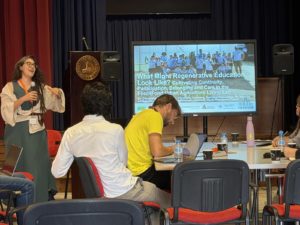
What Might Regenerative Education Look Like? Cultivating Continuity,
Participation, Belonging and Care in the Feed4Food Urban Agriculture Living Lab
Dr. Chrystalleni Loizidou¹, Katerina Televantou², Dr. Chrystalla Antoniou², Emmanouela Christofi¹, Dr. Vassilis Litskas³*, Dr. Dimitris Sarris¹, Myria Nikolaidou Tzioni²
This research examines how an Urban Living Lab can support regenerative, community-engaged learning by creating sustained relationships between children, a shared public space, and living ecological processes. The study draws on the Apostolos Varnavas-Strovolos Regenerative Education Pilot, implemented within the FEED4FOOD project at the Strovolos Urban Living Lab in Acropolis Park, Cyprus, from March to June 2026. Thirty primary school pupils aged 9-11, two teachers, and an interdisciplinary team of researchers and practitioners participated in regular garden-based sessions. Rather than applying a fixed pedagogical model, the pilot developed through cross-pollination between regenerative agriculture, permaculture, outdoor education, arts education, agronomy, biology, and conventional primary education. Activities included planting and caring for vegetables, sensory and ecological observation, land art, learning about pollinators, measuring soil temperature, and plant-growth experiments. The programme was continuously adapted to place, seasonality, children’s interests, and ecological change. Findings indicate that continuity was a key pedagogical resource. Repeated encounters with the same living environment enabled pupils to observe change over time, build on previous experiences, care for a shared space, and witness the cumulative effects of their actions. Teachers reported exceptionally high engagement, while pupils expressed a strong desire to return and distinguished the experience from classroom learning. Beyond environmental knowledge, the pilot supported richer observational practices, peer collaboration, responsibility, connection to place, and confidence in contributing to ecological change. The study proposes continuity, participation, belonging, and care as four interconnected resources through which Urban Living Labs can cultivate social-ecological stewardship. It suggests that community-engaged, place-based learning can transform public green spaces into inclusive environments where young people participate meaningfully in the everyday making and care of sustainable urban futures.
Keywords: Urban Living Labs; Regenerative Education; Place-Based Learning; Social-Ecological Stewardship;
Community-Engaged Learning
Links:
Feed4Food: https://feed4food.eu/strovolos_living_lab/
PSUGO_PSUC_2026_Book_of_Abstracts